Labour Complaints and Employment Disputes in Qatar
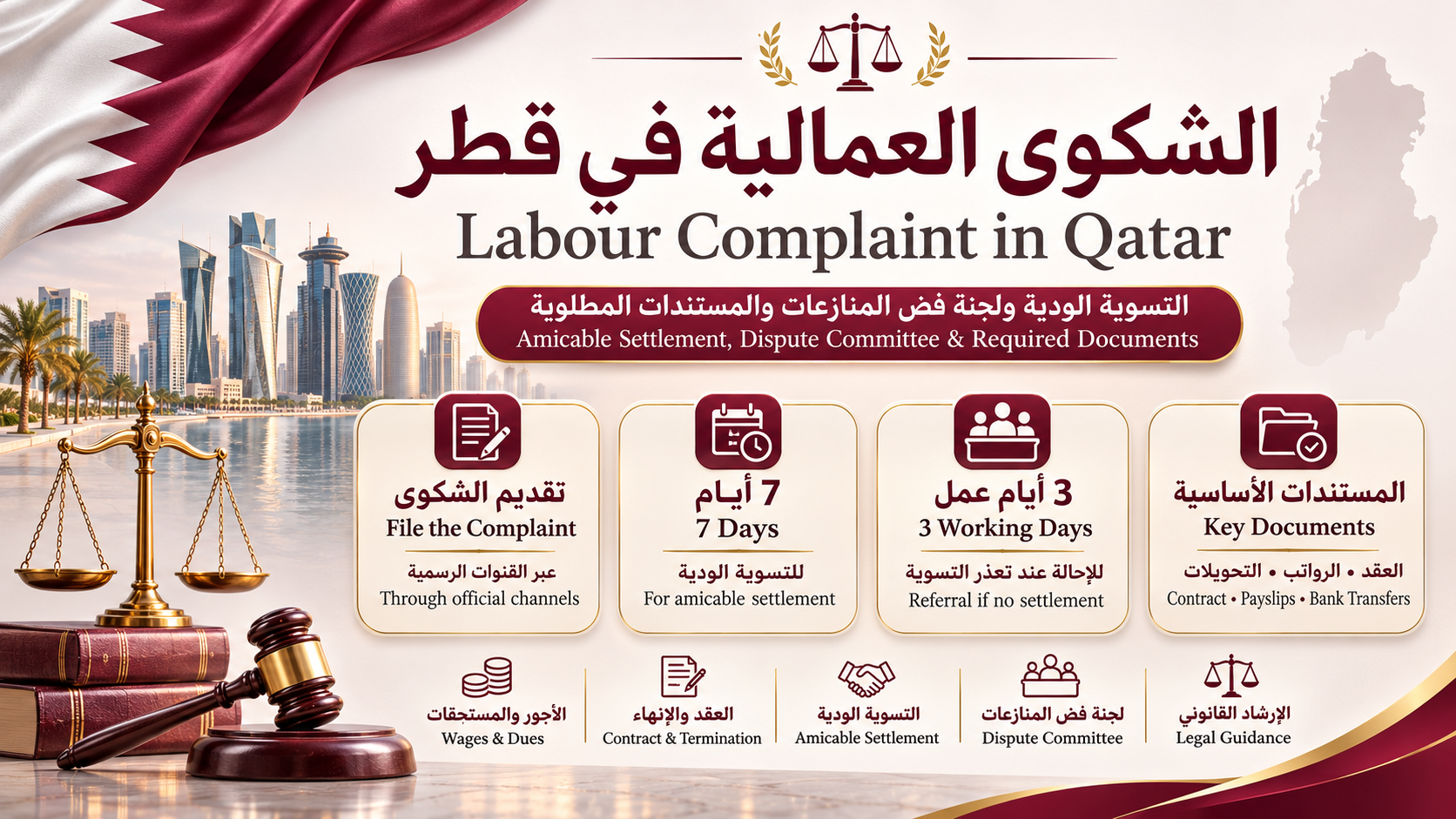
Has your employer withheld salary, disputed your final settlement or failed to resolve a workplace complaint? A labour claim in Qatar usually begins with documenting the problem and approaching the Ministry of Labour for amicable settlement, not immediately filing a court case.
This guide explains which complaints fall under the general Labour Law, how to prepare a clear claim, what happens under the 2026 dispute-resolution amendments, and how to protect important records and deadlines.
Labour complaint and dispute guides
Start with the main complaint route and explore related employment-law guidance.
Filing labour complaints and dispute resolution procedures.
Which workers and disputes does this process cover?
Qatar Labour Law No. 14 of 2004, as amended, governs many private-sector employment relationships. Its Article 115 bis sets a route for individual disputes concerning that law or the employment contract. The first question is whether your employer and role fall within this framework; the Qatar Labour Law overview explains the broader scope.
Not every worker follows exactly the same legal procedure. Domestic workers are principally regulated by Law No. 15 of 2017, and some employers, including relevant Qatar Financial Centre entities, operate under different employment regimes. Hukoomi's unified platform accepts certain domestic-worker complaints, but a shared filing channel does not mean all statutory committee procedures or remedies are identical. Check the competent authority before submitting.
Common reasons for filing a labour complaint
State exactly what happened and what outcome you seek. A complaint about missed salary is different from a complaint about disputed dismissal, even when they arise from the same employment relationship.
Late or unpaid salary
Missing wages, repeated delays, incomplete bank transfers or disputed allowances. Compare the contract with the dates and amounts actually received.
Final settlement and gratuity
Disagreements over basic wage, end-of-service gratuity, unused leave, deductions or unpaid amounts after resignation or dismissal.
Contract and termination disputes
Conflicting contract terms, a disputed last working day, notice-related amounts or an alleged unlawful ending of employment.
Working conditions and other rights
Claims involving recorded overtime, leave, contractual obligations or other protections that fall within the applicable labour regime.
For example, if you were promised QAR 4,000 a month but received QAR 3,000 for two months, a useful claim identifies the two pay periods, the contractual amount, what reached your account and the QAR 2,000 difference. Treat gratuity, leave or notice-related amounts as separate items and verify their individual legal basis.
How to start and follow a labour complaint in Qatar
- Check the applicable regime and employer. Confirm the company name on the contract, the work relationship, and whether the Ministry of Labour handles this type of claim.
- Write a short, dated account. Record when the problem began, what you requested from the employer, each amount still due, and your preferred resolution. Keep accusations factual and tied to supporting documents.
- Preserve and organise evidence. Save readable copies of the contract, wage transfers, payslips, messages and any dismissal or resignation notice. Retain originals and do not edit records.
- Use the official complaint channel. Follow the current identification, submission and upload instructions on the government labour-complaint service . Keep the complaint reference and any confirmation message.
- Participate in the settlement stage. Reply to authorised Ministry communications and attend appointments. Compare any offered amount with your itemised claim before accepting a final settlement.
- Follow a referral or hearing notice. If the statutory settlement process does not result in an accepted agreement, track referral to the competent Labour Dispute Settlement Committee, preserve notices and prepare your documents for the hearing.
What changed in the dispute process under Law No. 9 of 2026?
Article 115 bis, replaced by Law No. 9 of 2026, requires eligible individual disputes to be referred to the Ministry's competent department for amicable settlement before the committee stage. It specifies the following procedural periods:
Within 7 days
The department takes the steps needed to attempt an amicable settlement after receiving the dispute.
Following 7 days
The department presents the outcome to both parties; an accepted settlement is signed and approved.
Next 3 working days
Where no settlement is reached or accepted, the department must refer the dispute to the committee with a case summary and documents.
After referral
The committee secretariat sets a hearing within 3 working days, for a date within 7 working days of referral, and gives at least 3 days' notice.
These are statutory administrative and scheduling periods, not a guarantee that a contested claim will be finally decided or paid within a few weeks. Follow the actual summons and notifications you receive, especially if a hearing or challenge deadline applies.
If both sides accept a department-mediated settlement, signed minutes approved by the department have the force of an enforceable instrument. Under Article 115 bis/4, a reasoned committee decision ending the dispute likewise has that force. The committee may use electronic systems after verifying the identity of the relevant party or witness. Do not agree to a settlement without checking what rights it resolves.
Documents to prepare before and after filing
A simple one-page chronology can be more useful than an unsorted folder of screenshots. For each disputed salary month, write down the agreed pay, amount received, shortfall and supporting bank entry. For dismissal or contract disputes, add the relevant dates and written notices. Keep a copy of everything you submit and a record of each contact with the Ministry.
Deadlines, settlement offers and other important precautions
Article 10 of the general Labour Law sets a one-year period from termination of the employment contract for claims to the worker benefits it covers, subject to the law's relevant qualifications. Amended Article 115 bis suspends the statutory period when a request for settlement is submitted to the department, for the periods described in that article. That does not mean you can safely ignore an approaching deadline or assume every type of claim is treated alike.
Before signing a settlement, check whether it covers only one salary period or also leave pay, gratuity, notice and other rights. Ask for a written breakdown and keep the signed version. If your identity is disputed, the employer has closed, you face pressure to sign, or the committee has already issued a decision, seek prompt individual advice about the available procedure and deadlines.
For the underlying wage, contract and termination rules, read the main Qatar Labour Law guide. Keep your claim documents and any Ministry notices together so that the next step can be assessed accurately.
Frequently asked questions about labour disputes in Qatar
Where do I submit a labour complaint against my employer in Qatar?
For matters within the Ministry of Labour's jurisdiction, use the official Unified Platform for Complaints and Whistleblowers or the Ministry's current authorised channels. The correct process depends on the employment category; keep your submission reference and any notices.
Do I need a lawyer to file a labour complaint?
A worker can generally start an eligible Ministry complaint without first retaining a lawyer. Legal advice can be helpful if jurisdiction, calculations, evidence, settlement terms or procedural deadlines are disputed.
What happens after I file a labour complaint in Qatar?
Under Article 115 bis as replaced by Law No. 9 of 2026, eligible individual disputes first go to the Ministry's competent department for amicable settlement. If no accepted settlement results, the department must refer the dispute to the Labour Dispute Settlement Committee in accordance with the statutory procedure.
How long does the Ministry's amicable settlement stage take in 2026?
Article 115 bis provides up to seven days for the department to take amicable-settlement steps and the following seven days to present the outcome. An unresolved or rejected case is to be referred within the next three working days. These statutory stages do not guarantee a final case decision by a particular date.
Can I claim unpaid salary after leaving my job?
Ending employment does not itself cancel earned wages. But Article 10 sets a one-year period from contract termination for the labour-benefits claims it covers, subject to the relevant legal provisions. Filing a settlement request suspends that period for the period described in amended Article 115 bis, so obtain advice promptly about your particular dates.
What evidence should I attach to a Qatar labour complaint?
Prepare your contract, identification, employer details, payslips, bank transfers, relevant correspondence and a dated, itemised explanation of each amount or right claimed. The official platform determines which attachments are accepted.
Can domestic workers use the same complaint platform?
Hukoomi describes the unified complaint platform as covering complaints involving the Domestic Workers Law No. 15 of 2017 as well as covered private-sector employment. However, domestic workers have a separate legal regime; do not assume the general Labour Law's committee or compensation rules apply identically.
Is an amicable settlement or committee decision legally binding?
Under amended Article 115 bis, a settlement accepted by both parties, signed and approved by the competent department has the force of an enforceable instrument. Article 115 bis/4 similarly addresses reasoned final committee decisions. Review the actual terms and any available challenge procedure before acting.
Official legislation and government complaint resources
Consult the Arabic legal text and the 2026 amendment together: older translations of the general Labour Law may not incorporate the latest settlement provisions. The government service sets out the current method for submitting a complaint.
Need help reviewing a workplace dispute?
Bring your contract, salary records, a dated account of events and any Ministry notices or settlement proposal. Legal review can help identify the applicable procedure, missing evidence and time-sensitive decisions.
Information on this page is general and does not establish that a particular claim will succeed or that a fixed processing time applies.
About the Author
Written by Al-Khabir Law Firm & Arbitration — Official Legal Content. This article was prepared by Al-Khabir Law Firm & Arbitration’s legal team.
Need Legal Consultation?
Our team of specialized lawyers is ready to assist you with all your legal matters.
Contact Us Now