Post-Divorce Rights in Qatar: Financial Support, Custody, and Legal Steps
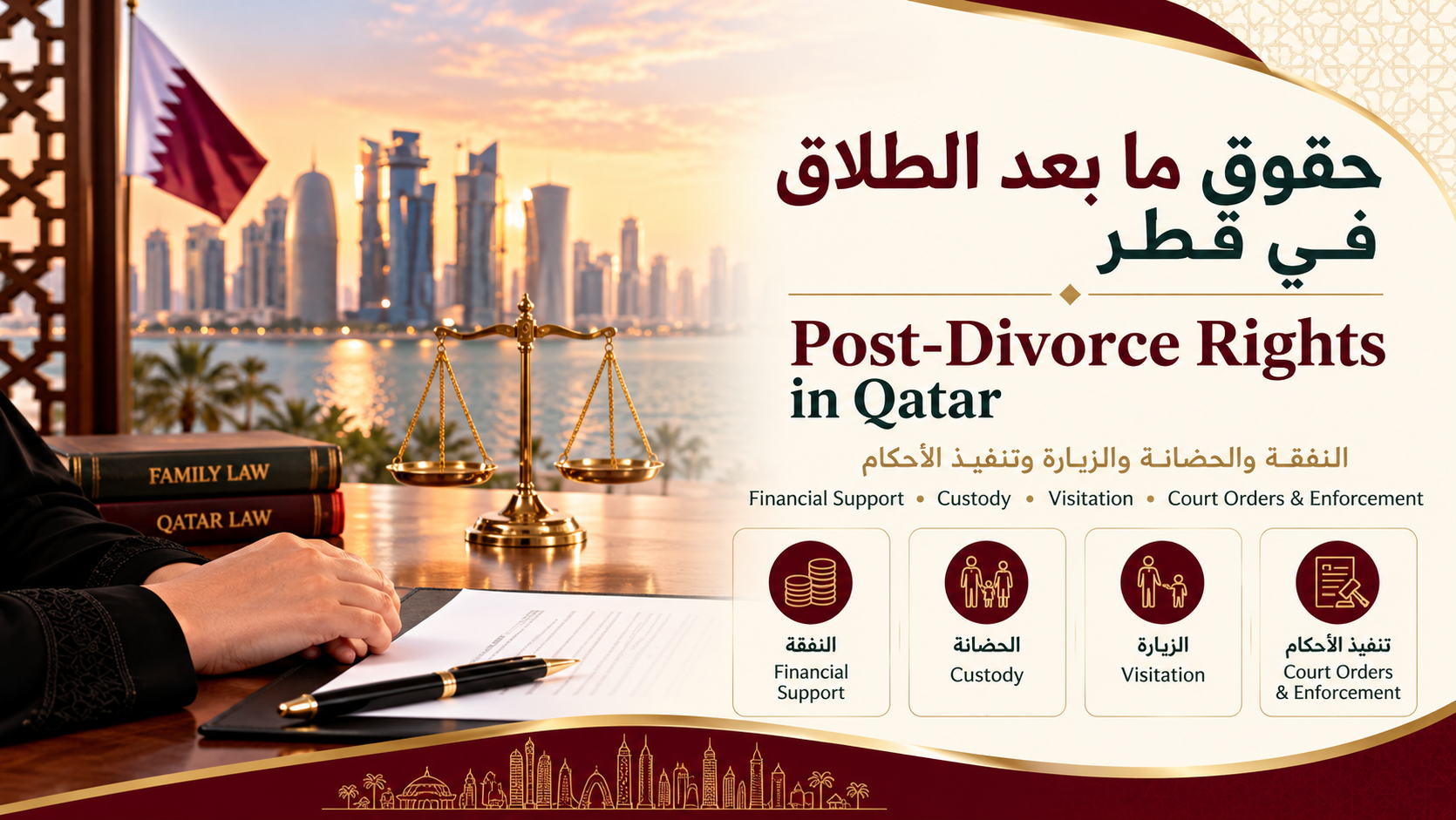
Post-Divorce Rights in Qatar: Financial Support, Custody, and Legal Steps
A divorce may end the marriage, but it does not settle every financial responsibility or question involving children. Knowing which rights belong to a former spouse, which belong to children, and which require a court order can prevent avoidable disputes.
This guide explains the practical next steps under Qatar Family Law No. 22 of 2006. For the wider process, see Divorce in Qatar.
Divorce Guides in Qatar
Related guidance on divorce, financial responsibilities, children and court procedures.
The main divorce guide covering procedures, documents, court steps, financial rights, custody, and post-divorce issues in Qatar.
A step-by-step guide to filing for divorce, required documents, court hearings, judgments, and procedural issues in Qatar.
A focused guide to amicable divorce, settlement terms, financial arrangements, children’s issues, and court documentation.
A guide to divorce certificates, proof of divorce, family documentation, and using divorce documents in Qatar.
A focused guide to khul under Qatar Family Law Articles 118–122, including consideration, dowry repayment, protected child rights, reconciliation, and the court route where spouses do not agree.
Legal support for divorce strategy, settlement, court procedures, custody, alimony, and post-divorce disputes.
A related guide to child custody, visitation, parental responsibilities, and custody disputes that commonly arise during or after divorce.
A related guide to child support, spousal maintenance, financial claims, and support obligations that may follow separation or divorce.
A related guide to Family Court procedures, required documents, hearings, and case preparation in Qatar.
Which rights continue after divorce in Qatar?
It helps to separate personal financial claims from children's independent rights. The basis of a claim may be the Family Law, the marriage contract, a settlement or a court order. Do not assume that a certificate proving divorce also settles the amount payable.
Waiting-period maintenance
Article 70 addresses maintenance during the iddah (waiting period), with qualifications depending on how the marriage ended and whether the woman is pregnant. This is a distinct issue from ongoing child support.
Post-divorce compensation (mut'ah)
Under Article 115, enjoyment compensation may be due where the divorce is attributable to the husband. The provision includes an insolvency-related exception and caps the assessment at three years of maintenance, rather than granting a fixed automatic sum.
Unpaid dowry or agreed financial amounts
Check the marriage contract, any deferred mahr, the court judgment and signed settlement. Whether a particular amount remains payable, has been paid or was validly waived depends on the documents and the applicable divorce route.
Child support and custody expenses
A child's financial needs do not disappear with the marriage. Article 75 addresses parental child maintenance; Articles 178 and 181 separately address custody remuneration and suitable accommodation or rent in defined circumstances.
If the parties reached an amicable agreement, compare its wording against the legal method of divorce. An agreement made around talaq is not necessarily khul under Article 118. Under Article 120, children's rights and custody cannot form part of khul consideration. Our Mutual Divorce in Qatar guide explains how to record the agreed terms clearly.
Iddah maintenance, mut'ah and deferred mahr are different claims
Iddah maintenance concerns support during the legally applicable waiting period. Article 70 provides for it after divorce or rescission subject to its qualifications, and addresses pregnancy until delivery. Establish the form of dissolution and relevant dates before making a calculation.
Mut'ah (post-divorce enjoyment compensation) is addressed by Article 115. It applies where divorce is attributable to the husband, subject to the specified exception concerning divorce for non-support caused by insolvency. The court considers the former husband's means and the divorced woman's circumstances; the statute sets a maximum, not a standard payout.
Deferred mahr is a contractual matter requiring review of the marriage contract, payment records and any valid settlement. It should not be confused with mut'ah or iddah maintenance. Before accepting a single lump-sum settlement, ask for each asserted claim to be identified separately, along with any express waiver or proof of prior payment.
Child custody, parental responsibilities and visitation
Child custody is about daily care. Guardianship and related legal decision-making are separate questions; a custodial parent does not necessarily have every power concerning passports, schooling or travel. Qatar's Family Law directs attention to the child's welfare when custody is disputed.
Article 173 ordinarily ends female custody when a boy completes 13 or a girl completes 15, but allows judicial decisions based on the child's interest, including possible extensions. The law does not permit a guardian simply to take the child without consent or judicial permission when female custody ends. See Child Custody in Qatar for detailed considerations.
Under Article 186, parents may agree on visitation; when agreement fails the court can set the timing and location, taking the child's age and needs into account. Court visitation orders are immediately enforceable, and a change can be requested through the court. Keep handovers civil and documented rather than using visitation to pressure the other parent over money.
Children's financial support, housing and custody payment
Child support is separate from maintenance for a former spouse. Article 75 sets out the father's obligation for a child without adequate means, including conditions relating to age, study and incapacity. A support discussion should account for the children's real needs and the applicable court assessment, not a fixed amount asserted without evidence. Our Child Support and Alimony in Qatar guide considers these issues in more depth.
Article 178 addresses remuneration payable to a female custodian after the marriage actually ends, taking relevant circumstances into account. Article 181 addresses custody accommodation or rental contribution in defined situations. Neither provision should be paraphrased as an unconditional right to keep the former marital home; the facts, housing arrangements and court determination matter.
Keep housing expenses, rent agreements, education costs, medical bills and bank receipts in organized files. If circumstances materially change, ask whether the existing order should be varied instead of treating a private text exchange as an amendment to a judgment.
Travel, passports and official documents after divorce
Article 176 regulates possession and delivery of a child's passport, and allows the court to place it with the female custodian where delivery might otherwise be delayed. It also addresses birth certificates and identification documents. Article 185 contains specific rules on travel with children and potential travel restrictions. Do not assume either parent has unlimited authority to take a child abroad.
For school registration, residence procedures or travel, ask the receiving authority whether it needs a divorce record, a custody or guardianship order, an original child document, or a certified copy. Once its divorce status is established, the proper document can be obtained through the relevant judiciary service. You can check the official Supreme Judiciary Council e-services portal for the appropriate document. For further document guidance, see Proof of Divorce in Qatar.
What to do after the divorce: a seven-step checklist
Confirm the legal divorce and its type
Keep the official divorce record or judgment and identify whether the divorce is revocable, irrevocable, khul or a court-ordered separation. If the event is disputed, resolve proof of divorce before relying on its financial consequences.
Collect orders and agreements
Keep the marriage contract, certified judgments, settlement terms, previous custody or support orders and proof of service or finality where relevant. Separate orders may govern different rights.
Prepare a financial schedule
List deferred mahr, iddah maintenance, possible mut'ah, child support, custody remuneration, housing or rent, school and healthcare costs. Record due dates, amounts, receipts and any shortfalls without assuming each claim automatically applies.
Set out a workable parenting arrangement
Record where the children live, handover times, school and medical communication, holiday arrangements, travel permissions and passports. Put the children's needs first and check any existing court order.
Seek the correct court order
Article 114 provides for an immediately enforceable order, on an interested party's request, concerning iddah maintenance, child support, custody and visitation. Where the issue is different, ask the court or lawyer which application fits.
Address non-payment or breaches promptly
Preserve a dated record of unpaid instalments, missed contact, correspondence and payment evidence. Check the enforceable wording and current judiciary procedures before applying for enforcement or modification.
Update records when needed
Ask the relevant authority whether an official divorce document, custody order, birth record, passport, authenticated translation or other document is required for schools, travel, employment or overseas use.
Documents to keep for financial claims and children
Not every claim needs every document. Start with what already exists, keep originals secure, and prepare legible copies for the actual court or government service.
Marriage contract, including clauses about mahr and any deferred amount
Official divorce certificate, decree or proof of the divorce, as applicable
Court orders on maintenance, custody, visitation, housing or enforcement
Children's birth certificates, IDs, passports and school records
Income evidence, necessary-expense records, bank transfers and receipts
Any written settlement and evidence of payments or alleged waivers
Messages recording missed visitation, outstanding support or travel concerns
Arabic translations, authorizations and certified copies where requested
If an ex-spouse does not pay or comply with a court order
Read the operative part of the judgment: what exactly does it direct, from when, and against whom? A maintenance order, custody transfer and visitation order may have different implementation steps. Article 187 treats specified child-related applications as urgent; Article 188 requires a gradual approach to enforcing custody transfers that respects children's welfare.
Keep a timeline of arrears or missed visits and attach dated payment statements or messages. Ask the Family Court in Qatar guide for court-preparation context, and check current filing or enforcement services directly. If safety is at stake, seek immediate qualified assistance. Neither parent should punish the other by ignoring a children's order or making unilateral changes.
Frequently asked questions about rights after divorce in Qatar
What financial rights can a wife claim after divorce in Qatar?
Depending on the legal route and facts, issues can include iddah maintenance under Article 70, enjoyment compensation (mut'ah) under Article 115, unpaid or deferred mahr under the marriage contract, and separate child-related claims. A divorce alone does not establish that every listed payment is due; review the judgment, documents and any valid settlement.
Is mut'ah compensation automatically three years of alimony?
No. Article 115 sets conditions for enjoyment compensation and a ceiling of three years of maintenance. The amount is assessed with reference to the husband's means and the divorced woman's circumstances; the maximum is not an automatic award.
Who pays child support after divorce in Qatar?
Article 75 places maintenance for a child without sufficient property on the father subject to the conditions set out in the law. The amount, duration, expenses and any order depend on the child's circumstances and the applicable statutory requirements.
At what age does a mother's custody end in Qatar?
Article 173 ordinarily sets the end of female custody at 13 for a boy and 15 for a girl, while allowing the court to extend custody or decide otherwise in the child's interests. It does not authorize either parent to take the child automatically when an age is reached.
Can divorced parents agree on child visitation?
Yes. Article 186 recognizes agreed visitation arrangements. If there is a dispute, the judge may set the schedule and location, and an existing court visitation order can be revisited through the appropriate application.
Who keeps a child's passport after divorce?
Article 176 generally allows the guardian to hold the child's passport, with delivery for travel, and allows a judge to order the female custodian to retain it if justified. Birth certificates and other identity records are addressed separately in the same provision.
Can a custody or maintenance order be enforced immediately?
Article 114 describes immediate enforceability for its specified post-divorce order. Article 186 also provides for immediate enforceability of court visitation orders. The actual application and enforcement steps depend on the order's wording and current court procedures.
Does khul affect the wife's financial rights after divorce?
It can. Khul under Article 118 has its own consideration and settlement rules. Article 120 does not permit child custody or children's rights to be surrendered as khul consideration. Check the specific terms before assuming a general waiver extinguishes every claim.
What if a former spouse refuses to pay or follow a visitation schedule?
Keep the order and a clear record of missed payments or visits. Use the competent judiciary route for enforcement or adjustment, rather than relying on informal retaliation or changing custody arrangements yourself. Seek case-specific advice where there is an urgent child-safety issue.
Qatar Family Law and official court sources
The relevant statutory starting point is Qatar Family Law No. 22 of 2006, available on Al Meezan. Procedures and service requirements should be checked with the competent authority before filing.
Need advice about your rights after divorce?
A review of the divorce route, marriage contract, court orders and children's circumstances can help you understand which claims or steps apply. Contact the office for case-specific guidance or read the Divorce Lawyer in Qatar guide.
Office hours: Saturday–Thursday, 9:00 AM–5:00 PM. Bring your divorce record, marriage contract and any relevant court orders.
About the Author
Written by Qatar Law Firm — Official Legal Content. This article was prepared by Qatar Law Firm’s legal team.
Need Legal Consultation?
Our team of specialized lawyers is ready to assist you with all your legal matters.
Contact Us Now