Labour Dispute Resolution Committees in Qatar Explained
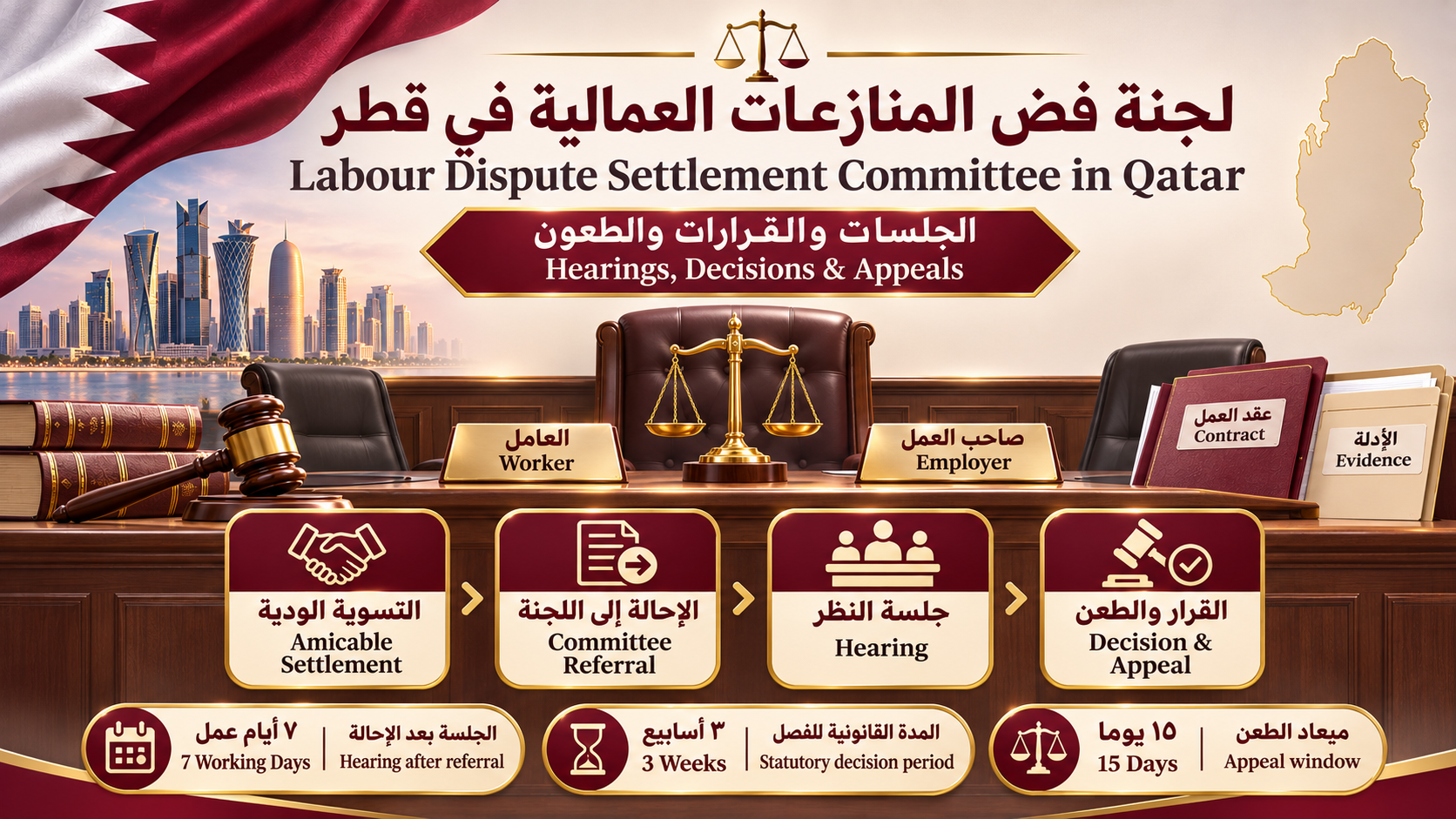
If your Qatar labour complaint cannot be resolved through the Ministry of Labour, the next stage may be a Labour Dispute Settlement Committee. This specialist body examines eligible employment claims, considers the evidence and issues decisions that can be enforced.
This guide explains committee referrals, hearing dates, evidence, decisions, appeals and enforcement, including the procedural changes under Law No. 9 of 2026. To understand the earlier stages, see the labour complaints overview or the online complaint filing guide.
Labour dispute hearing and related guides
Committee proceedings, the Ministry complaint route and general Qatar labour-law rights.
Labour Dispute Resolution Committees
What does Qatar's Labour Dispute Settlement Committee do?
Under Article 115 bis/1 of Labour Law No. 14 of 2004, one or more Labour Dispute Settlement Committees sit within the Ministry framework and are chaired by a first-instance judge. Under Article 115 bis/2, they have exclusive jurisdiction over individual disputes arising from the general Labour Law or an employment contract, subject to the legal scope and transitional rules.
Typical questions include wages owed, contractual entitlements, notice, end-of-service sums and disputes about termination. The committee assesses the legal basis, the parties' statements and their documents; filing a complaint does not automatically establish that a payment is owed. The statutory tribunal is different from a company's internal grievance channel or a workplace joint committee.
The general Labour Law does not govern every employment relationship in Qatar. Domestic workers, certain public-sector and energy-sector positions and other special regimes require a separate jurisdiction check. For the wider rules, consult the Qatar Labour Law overview.
From Ministry complaint to committee hearing: the 2026 process
Law No. 9 of 2026 replaced Article 115 bis. The Ministry's competent department first attempts an amicable settlement within seven days of the dispute being presented, then communicates the outcome within the following seven days. If both sides agree, the signed, approved settlement record is enforceable. Where settlement fails or is not accepted, the referral timetable applies.
1. Ministry settlement first
An eligible individual labour dispute is presented to the Ministry of Labour's competent department, which attempts an amicable settlement. The committee is normally not the first filing destination.
2. Referral if there is no accepted agreement
Under amended Article 115 bis, the department refers an unresolved or unaccepted dispute within the following three working days, sending a memorandum of the claims, responses, supporting papers and its observations.
3. A hearing is scheduled
The committee secretariat has three working days from referral to set a hearing date not later than seven working days after referral; the worker and employer must receive at least three days' notice.
4. The committee considers the evidence
The parties explain their claims and defences. The committee may seek clarification and hear evidence under the applicable procedural rules. It can use electronic systems after verifying relevant identities.
5. Decision, implementation or appeal
A reasoned decision ending the case has the force of an enforceable instrument. If a party seeks a challenge, the statutory appeal time and execution rules matter immediately.
Calendar days and working days are not interchangeable. The amended article distinguishes them. Save your original Ministry reference, any transfer notice, and the summons showing the actual place, date, time and permitted attendance method. Respond to official messages rather than relying on estimated dates.
How to prepare for a labour committee hearing
A hearing is easier to follow when your claim is organised as a short chronology plus a numbered evidence bundle. Prepare the following before the scheduled date, and bring originals if the notice requests them:
Identity and notices
QID or other official ID, complaint reference, referral papers, hearing summons and any representative's authorisation.
Employment relationship
Contract, amendments, job title, hiring and termination dates, payslips, written company policies relevant to the dispute.
Amounts and calculations
For every unpaid period, show the agreed salary, bank transfer, shortfall and total; calculate leave, notice and gratuity separately where claimed.
Communications and response
Dated correspondence, payment requests, termination letters, the employer's position and any settlement offer or signed minutes.
Readable presentation
An indexed evidence folder, a short chronology, a one-page claim summary and translations where required by the authority.
Example: for a claim involving two unpaid salary months, present the contract's agreed monthly amount, the pay dates, each bank credit and the difference. List any gratuity or unused-leave claim separately. If the employer disputes the dates or payments, identify the exact document or message relevant to each disagreement.
What happens at the hearing?
Follow the summons and arrive or connect as instructed. Be ready to identify yourself, state the remedies sought and explain each disputed fact concisely. The employer may answer and provide records. Under Council of Ministers Decision No. 35 of 2026 (effective 20 October 2026), either party can authorise another person to attend, even if that person is not a spouse or relative. The chair can check who is appearing and in what capacity; confirm the current authorisation and identification requirements.
Under Article 115 bis/2, the committee is directed to decide a dispute within three weeks from the first hearing. This is a statutory decision period, not a promise that a case will resolve or funds will be collected on a particular day. Article 115 bis/4, amended in 2026, expressly permits the use of electronic systems after verifying a party's or witness's identity. An online hearing is possible where arranged, but not guaranteed for every case.
If you do not understand a calculation, need to respond to new evidence or cannot attend, contact the competent office through the method shown in your notice as early as possible. Do not assume silence or nonattendance has no consequences.
Committee decision, appeal and enforcement
A decision ending the dispute must be reasoned, and Article 115 bis/4 (as amended in 2026) gives it the force of an enforceable instrument. That legal status is different from a guarantee of immediate recovery; if payment is not made voluntarily, appropriate enforcement steps may still be necessary.
Challenge within 15 days
Article 115 bis/6 permits an affected party to appeal to the competent Court of Appeal circuit within 15 days. The statutory start differs according to whether the decision was issued in the party's presence or in absentia; verify the relevant service and decision dates.
Appeal does not automatically suspend execution
An appeal alone does not stay enforcement. Under Article 115 bis/6, only the competent Court of Appeal circuit can order the suspension contemplated by the law.
Keep a complete copy of the decision, the proof or date of notification, and any payment or enforcement correspondence. If a decision is adverse or only partly awards your claim, get case-specific advice before the appeal window closes. Workers' covered claims enjoy the judicial-fee exemption in Article 10, but private assistance and ancillary expenses are separate questions.
Common mistakes that can weaken a labour dispute case
- Confusing the routes: treating a workplace joint committee or direct court filing as a substitute for the competent Ministry referral procedure.
- Submitting only a total amount: failing to identify the salary periods, contract terms and calculation behind each requested sum.
- Missing notices: failing to monitor the official phone number, messages, hearing instructions or decision notification.
- Assuming all cases have the same time limit: Article 10 contains a one-year limit for covered employment-benefit actions measured from contract termination, while amended Article 115 bis addresses suspension during specified settlement periods; other issues can differ.
- Confusing an enforceable decision with money already received: a decision may require separate implementation or enforcement steps.
If you have not yet submitted the initial complaint, the Ministry filing walkthrough deals with login, attachments and complaint tracking. This page addresses the later adjudication stage.
Frequently asked questions about labour dispute committees in Qatar
What is Qatar's Labour Dispute Settlement Committee?
It is the specialised committee established under the Labour Law to decide eligible individual employment disputes after the Ministry's amicable settlement stage. It is chaired by a judge of the Court of First Instance and follows statutory procedural rules.
Can I go straight to the labour committee without a Ministry complaint?
For an individual dispute governed by amended Article 115 bis, the law requires submission to the competent Ministry department for amicable settlement first. An unresolved or unaccepted dispute is then referred to the committee.
How long does it take to get a labour committee hearing in Qatar?
After referral, the secretariat has three working days to set a hearing for a date no later than seven working days from referral, with at least three days' prior notice. These are statutory scheduling periods, not a guarantee of a final outcome on that date.
Must a labour dispute committee decide the case within three weeks?
Article 115 bis/2 states that the committee shall decide a referred dispute within three weeks of the first hearing. Actual progress can depend on evidence and procedural developments; track official case notices rather than assuming a guaranteed payment date.
Can a committee hear an unpaid salary or gratuity claim?
If the claim arises under the general Qatar Labour Law or the employment contract, it is generally within the committee's statutory remit, subject to coverage and jurisdiction. Bring a month-by-month statement and supporting contracts and bank records.
Are online or remote hearings possible in 2026?
Yes. Article 115 bis/4, as amended by Law No. 9 of 2026, permits the committee to use necessary electronic systems after verifying the identity of the relevant party or witness. Follow the specific instructions on the summons; do not assume every hearing is remote.
May someone who is not my relative represent me at the hearing?
Council of Ministers Decision No. 35 of 2026 amended the committee procedures to allow either party to authorise another person to attend, even if that person is not a spouse or relative. The committee chair can verify the appearing person's capacity; follow current authority-to-act requirements.
Can I appeal a Labour Dispute Settlement Committee decision?
Article 115 bis/6 generally allows an affected party to challenge the decision before the competent Court of Appeal circuit within 15 days, with the statutory starting point differing for decisions issued in the party's presence and decisions issued in absentia. Have the decision and notification date checked immediately.
Does an appeal automatically stop enforcement of a labour decision?
No. Article 115 bis/6 provides that a challenge does not itself suspend execution; the competent Court of Appeal circuit may order suspension. A reasoned final committee decision has executory force under amended Article 115 bis/4.
Is the Labour Dispute Settlement Committee the same as a workplace joint committee?
No. A workplace joint committee is a labour-management body concerned with workplace relations. The specialised Labour Dispute Settlement Committee adjudicates covered individual disputes after the Ministry referral stage.
Do all workers in Qatar use the same committee?
No. The general Labour Law excludes or treats some categories under special legislation, including domestic workers and certain government or sectoral employees. Confirm the correct regime and forum before relying on the committee procedure in this guide.
Official legislation and procedure references
The 2026 Labour Law amendment and October 2026 committee-procedure amendment are authoritative in Arabic. The Ministry's older English Labour Law PDF is useful for articles not replaced in 2026, including the committee framework and appeal, but must be read together with the official amendment and current procedural decisions.
Need to prepare for a labour committee hearing?
A review of your referral, evidence bundle, calculations and hearing notice can help clarify the disputed issues and any urgent appeal or enforcement deadlines.
General information only; the law, referral record and notices in your individual case determine the applicable process.
About the Author
Written by Al-Khabir Law Firm & Arbitration — Official Legal Content. This article was prepared by Al-Khabir Law Firm & Arbitration’s legal team.
Need Legal Consultation?
Our team of specialized lawyers is ready to assist you with all your legal matters.
Contact Us Now